Meeting Every Child’s Needs
With each year that goes by at Twegashe School, we are seeing more clearly the importance of teaching to individual children’s needs. We have been gradually honing our school program to make this kind of teaching possible.
Staffing
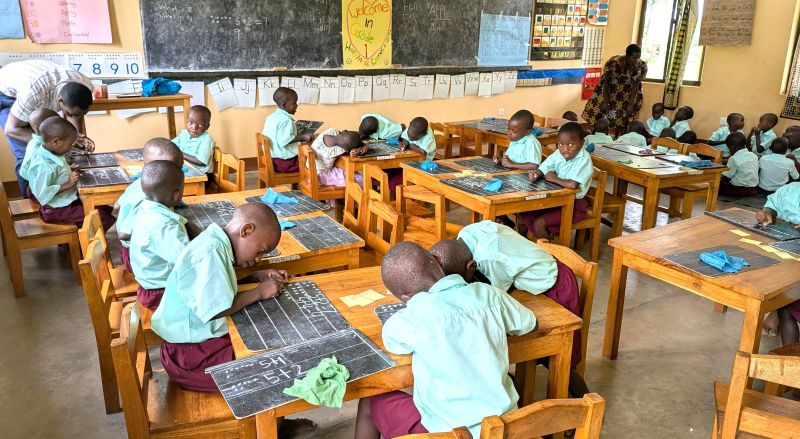
In the past three years we have hired seven additional teachers although we only added four new classes of children in those years. We now have two teachers in each classroom of fifteen pre-k and kindergarten students, two teachers in grade one, and two teachers during small group reading in grades two and three.
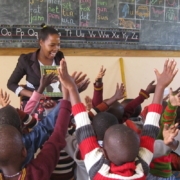
 In kindergarten (four and five-year-olds), this is allowing teachers to spend more one-on-one time with students so they can direct their conversation to individual students and ensure better engagement, comprehension, and learning. Much of the day for Twegashe kindergarten students is spent doing Montessori activities. This is by nature individualized. Students choose the activities they want to work on, and work through those activities at their own pace. The teacher is there as a guide and facilitator.
Having two teachers in grade one is new this year. Our teachers have found that teaching a class of thirty first graders the same thing in the same way at the same speed just doesn’t work for many first graders. With two teachers available all the time, both reading and mathematics can be done in small groups arranged by level. The teachers have testified that this is working much better, and is allowing them to provide instruction that more closely matches each student’s needs.
Small Group Reading Instruction
 We are using the Readwell curriculum in grades one and two. In both grades, during small group reading, one teacher takes the stronger readers and the other takes the group that needs more support and more time. These groups of fifteen are subdivided by ability into two or three smaller groups. The teacher then reads with each group separately for twenty to thirty minutes at a time, while the others are engaged in independent activities. This allows children to progress through the Readwell small group reading units at their own speed.
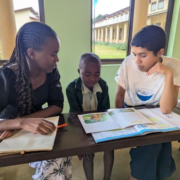 For some children, even small group reading instruction doesn’t provide enough differentiation. Karita started second grade quite far behind everyone else in the class; none of the Readwell groups was the right level for her. We were fortunate to have a volunteer early in the year who had an interest and experience in tutoring. She started working with Karita individually while her classmates were doing small group reading. After the volunteer left, our newly hired bookkeeper – who wears many hats at Twegashe – took over working with Nikita. She is now progressing through the Readwell units at a good pace, and will soon have caught up with some of her classmates. Very importantly, Karita loves these opportunities to read with Miss Jane.
This year’s grade three Twegashe students are more uniform in their reading ability, except for a few who need extra support. These children have their own teacher during their daily English reading period so they can practice reading at the appropriate level.
Individualized Reading Instruction Online
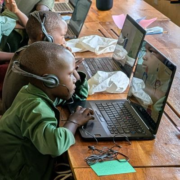 One of the independent activities our first and second grade teachers use during small group reading is a donated online reading program called Lalilo. This interactive program uses students’ responses to provide lessons and exercises appropriate to their level, continuously adjusting to provide more practice or further instruction as necessary. We’re very grateful for the donated Readwell curriculum, the donated laptops and this donated online program which are helping each of our kids learn to read at the level that is right for them.
A Special Case
Aidan is another second grader who needs his own individual program, but not just for reading. Visitors who have had experience with special needs kids have suggested that he probably has a form of autism. Were he in a US school, he would have his own I.E.P. and dedicated staff. We don’t have the resources to provide such extensive support, and there is no system in Tanzania to help kids like Aidan unless their family can afford to send them to a private school for special needs children. Aidan’s family certainly can’t afford that so we are doing the best we can. Aidan has made considerable progress since kindergarten. He is above Karita, for example, in reading ability. But he has trouble staying focused on any task for more than a few minutes. Our second-grade teacher, Madam Brigitha, has figured out a system that seems to work quite well. She has set up a special location in the breakout room next to their classroom with building materials such as Legos. When Aidan feels the need to change activities, he just gets up on his own and goes to go to the breakout room do some construction!
Reaching Different Learning Styles
 Mr. Erick, who teaches math in the upper grades, doesn’t have the luxury of an extra teacher, but through Twegashe’s teacher-training program, and through working with donated US curriculum materials, he has learned to use a variety of teaching methods to reach different learning styles. For example, his third graders are learning multiplication through the area model. After using math boards to draw rectangles, then using plastic tiles to construct rectangles, he had his kids out on the sports field lining up in varying numbers of rows and columns to engage his most kinesthetic learners. We’ve also seen students scattered around his classroom on their bellies on the floor working on their math facts. Mr. Erick said many of them are more comfortable that way than in chairs at their desks. Whatever works!
Looking Ahead
The educational program at Twegashe School is still a work-in-progress. The school is not yet fully enrolled. Every year we’ve been hiring and training new teachers. In the upper grades we have had very few years of observations to help us learn what works and what doesn’t. On top of that, two years ago the government introduced a major curriculum change. Never-the-less, it has already become clear that differentiated instruction is critical to the success of many students, and we will continue to work in the direction of teaching to each child’s individual needs.